

Ports on the edge: why the next generation of giant ships already has a problem before it sails

The shipping industry is weighing another jump in vessel size. After settling on 24,000 TEUs as the benchmark for intercontinental routes, several leading carriers are now looking at 27,000 TEU ships, a class larger still. China already proved the jump is technically feasible. In 2024 it unveiled a 27,500 TEU…
Trucking got 6% pricier in a year, and transport is now nearly half of Colombia’s logistics cost

Running a truck in Colombia cost 6.07% more in August 2026 than a year earlier, according to DANE’s road freight cost index. DANE is the national statistics agency, and the index tracks what it costs to operate a cargo vehicle: driver, tolls, fuel and maintenance. The index is up 5.62%…
The Suez Canal is back to 27% of traffic, but the gains are not equal. See what it means for global trade and freight costs.

September brought a clear signal for the Suez Canal: 27% of Asia-Europe capacity went back to using it instead of routing around Africa, according to Sea-Intelligence’s latest Sunday Spotlight report. Maersk, Hapag-Lloyd, MSC and CMA CGM have already reactivated several of their main services on the route. The result already…
UAE and Singapore: which Colombian products would enter tariff-free and why there is still no date

On September 28, Colombia’s Foreign Ministry sent the UAE and Singapore trade agreements to Congress, along with an update to the Pacific Alliance rules. All three were signed years ago and never put into force. None of them applies today. Before they do, each must go through Congress and the…
Typhoons in China are not bad luck this season, there is a cycle behind it

El Niño shows up every two to seven years, on an irregular cycle. When it does, it warms the Pacific and fuels more typhoons than usual. 2026 is one of those years. NOAA (the US National Oceanic and Atmospheric Administration) put the odds at 69% that this would be the…
Record port congestion: why Colombian cargo arrives late even when the jam is an ocean away
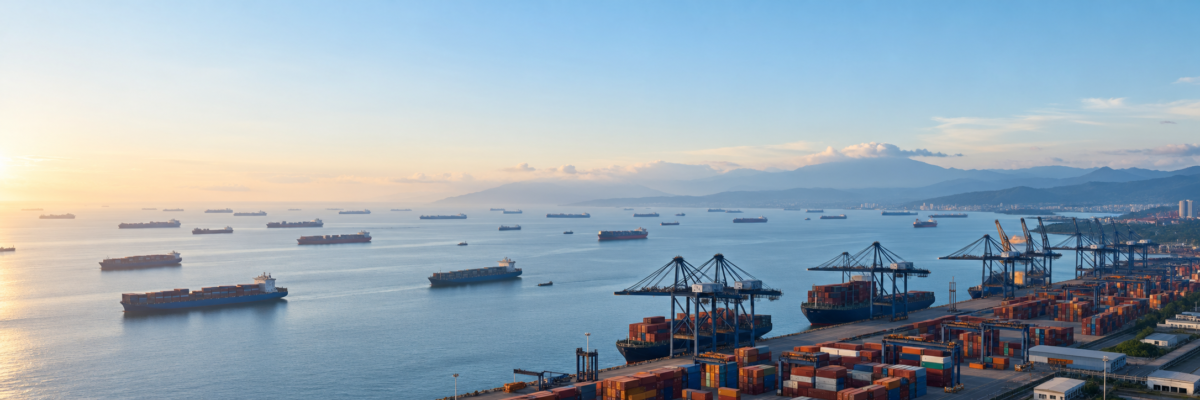
Port congestion is back at a level not seen since the pandemic. Linerlytica counts 4.3 million TEU waiting to berth at ports around the world, an all-time high in volume that leaves behind the roughly 4 million of 2022. One nuance usually gets lost in the headlines: that figure equals…
Two ports for all heavy machinery: what it changes for equipment importers

The government restricted heavy machinery imports into Colombia, and that reshuffled the board for any company bringing in heavy equipment. The measure does not close imports. Instead, it changes where they can happen, and that detail reshapes routes, timelines and customs clearance costs for importers in construction, infrastructure, agribusiness and…
Fertilizers at Puerto Antioquia: what export farming gains from the new route

The first fertilizer vessel from We Agro has arrived at Puerto Antioquia. The news itself is short. What’s worth looking at is where fertilizers now enter the country and who benefits from them coming in through here. The operation belongs to We Agro, part of the GreenLand Group. They built…
Port of Buenaventura: quake, gridlock and pricier cargo

On August 10, a magnitude 7.4 earthquake with its epicenter near San José del Palmar, in Chocó, shook southwestern Colombia for nearly two minutes. Buenaventura was left with damaged roads, interrupted services and a human toll the region still carries. For foreign trade the effect was immediate: the main Pacific…
Puerto Antioquia now operates with ICA phytosanitary inspection: what changes for importers and exporters

The ICA confirmed it is already carrying out phytosanitary and zoosanitary inspection at Puerto Antioquia, the Urabá terminal that began operating in February 2026. As a result, agricultural cargo moving through this point can meet sanitary requirements without being rerouted to another port, and that detail hits the timeline and…