El Niño shows up every two to seven years, on an irregular cycle. When it does, it warms the Pacific and fuels more typhoons than usual. 2026 is one of those years.
NOAA (the US National Oceanic and Atmospheric Administration) put the odds at 69% that this would be the most intense El Niño on record, with its peak expected in November. The closest precedent is 2015, also a strong El Niño year.
Shanghai and Ningbo-Zhoushan were hit by three typhoons in under two months. Bavi made landfall between July 11 and 13. Dolphin reached Zhejiang on August 9 with winds of 151 km/h and shut down Yangshan and Ningbo-Zhoushan. Saudel struck again on August 27 and 28, with the same intensity, between Xiangshan and Fuqing.
The numbers behind the closures
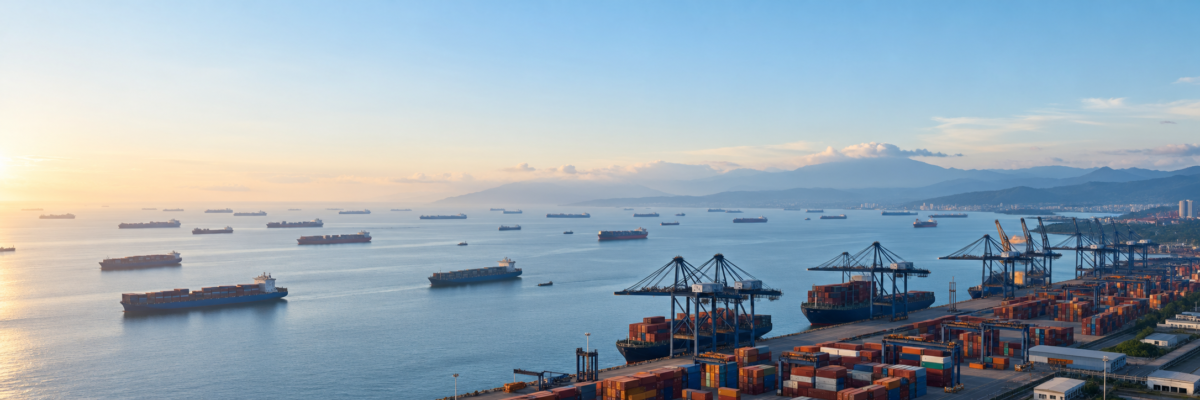
Before Dolphin, Shanghai already had delays of 4.4 to 8 days. Ningbo’s yard was running at 90% to 98% occupancy. After Saudel, the delay climbed to 8-9.5 days, with more than 139 container ships anchored and waiting for a berth.
What typhoons in China mean for importers
Three concrete effects:
- More variability in transit times, even on bookings made well in advance.
- Upward pressure on Asia-South America freight rates, as carriers have less available space when they skip calls or cancel sailings.
- Higher odds of extra delay at transshipment hubs like Singapore, Busan or Manila, where much of the cargo bound for Colombia connects.
What it means for exporters shipping from Colombia
Empty containers that normally return to South America to load exports depend on carriers closing their rotation in China without setbacks. A ship anchored for nine days waiting to berth does not free up that equipment in time. This is already reducing empty container availability in the region and rerouting itineraries that affect cargo such as soybeans, iron ore and copper from other South American countries. A Colombian exporter who needs a container for their next shipment to Asia is competing for the same scarce equipment.
El Niño in 2026 has not yet reached its peak, expected in November according to NOAA. The window for further typhoons in this part of China remains open.
What comes next
At Fenix we are tracking port behavior on this route over the coming weeks.
If you have a shipment planned to or from Asia in the coming weeks, talk to our team.
Get a quote on WhatsApp