
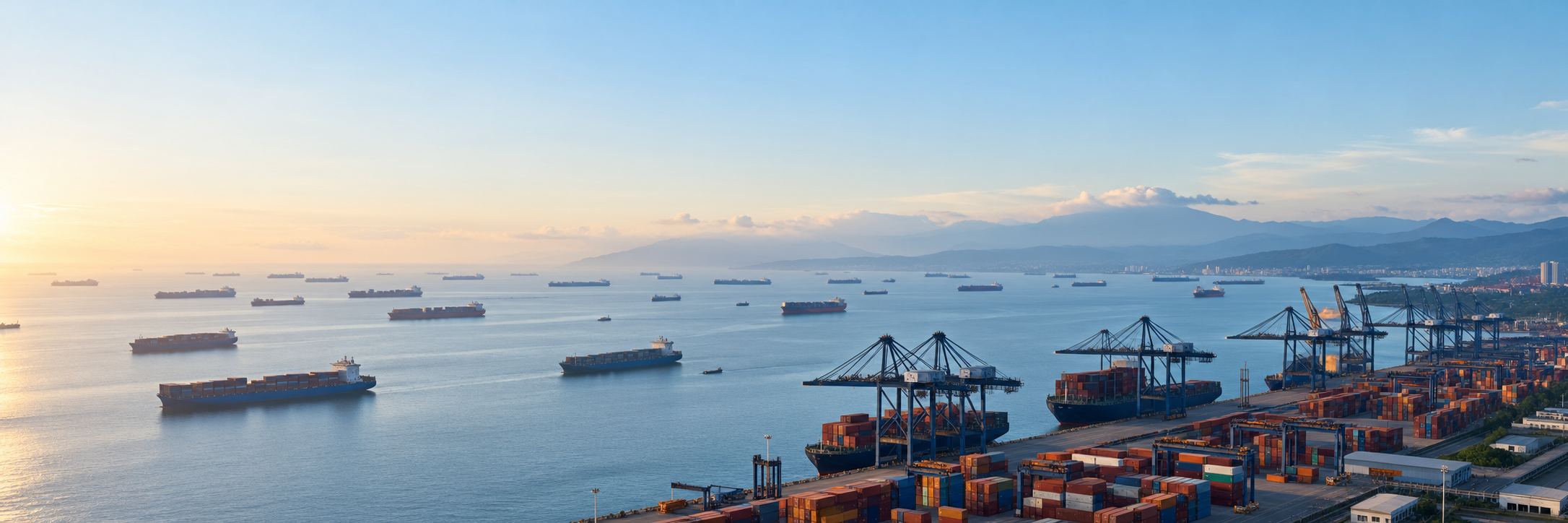
Port congestion is back at a level not seen since the pandemic. Linerlytica counts 4.3 million TEU waiting to berth at ports around the world, an all-time high in volume that leaves behind the roughly 4 million of 2022. One nuance usually gets lost in the headlines: that figure equals 12.6% of the global container fleet, still below the 15.7% that was tied up back then. This is not a carbon copy of 2022, and the hit to anyone moving cargo does not land where you would expect.
What weighs most today does not show up in the count of stranded boxes. It shows up on the calendar.
| Indicator | Figure | Source |
|---|---|---|
| TEU waiting for a berth | 4.3 million (record) | Linerlytica |
| Share of the global fleet | 12.6% (15.7% in 2022) | Linerlytica |
| Schedule reliability (July) | 56.4% | Sea-Intelligence |
| Average delay per call | over 5 days | Sea-Intelligence |
| Waiting times vs. 2019 | almost double | Drewry |
Where port congestion is concentrated right now
The epicenter is Asia. Shanghai alone holds more than 1.5 million TEU at anchor, with Singapore, Busan and Colombo showing queues that will not clear; Mumbai has the worst ratio of waiting ships to berth capacity. The build-up comes from several factors that hit almost at once: the typhoons that battered the Chinese coast, the diversions still routing around the Cape of Good Hope to avoid the Red Sea, and the draft restrictions at the Panama Canal, which cut daily transits and stretch schedules.
Reliability broke, and that is the cost no one sees
The most uncomfortable figure is not how many ships are waiting, but how far the clock has slipped. Schedule reliability fell below 60% (56.4% in July, according to Sea-Intelligence), and the average delay per call already tops five days. Drewry estimates that vessel waiting times have roughly doubled compared with 2019. The practical consequence is direct: the arrival date the schedule promises stopped being useful for planning production, dispatches or sales. Anyone planning against that theoretical date ends up planning against a number that no longer holds.
Why Colombia feels it magnified
The country rarely gets direct services from Asia. Colombian cargo travels connected, and that connection happens at the same hubs that are saturated today. A ship that arrives late in Shanghai or Singapore does not just lose its berth window, it can also miss the connection carrying the container toward us, and then the cargo waits for the next vessel. That jump of days drags through transshipment to Cartagena on the Caribbean or Buenaventura on the Pacific, and from there to the importer’s warehouse. The jam starts an ocean away and lands on the agenda of a client in Medellín or Bogotá.
Who wins and who loses
- The importer running tight inventory is the most exposed. Every arrival outside the window ties up working capital in longer transits and opens the risk of a stockout right when there is the least room to maneuver.
- The perishable exporter plays at a double disadvantage. Coffee, flowers and bananas travel against the clock, and roll-overs (shipments the carrier pushes to the next vessel for lack of space) punish sensitive cargo more than any other. When space is scarce, the shipper with steady volume and a firm contract keeps its slot on board; the occasional one goes to the back of the line.
- Carriers, for now, are holding rates that would be lower without this congestion. And terminals and real-time visibility platforms are gaining ground, because in a market where the schedule lies, knowing where each ship actually is has come to matter as much as the freight rate.
The backdrop the industry itself is starting to admit
There is a shift in tone worth noting. PortXchange, one of the platforms that monitors port traffic, has been pointing out that much of this backlog is not explained by weather or politics, but by decisions made late and with poor coordination among carriers, ports, terminals and forwarders. The underlying read is that unpredictability has stopped being a passing anomaly and settled in as a market condition, at least while this cycle lasts.
For Colombian foreign trade, that reshuffles the priorities. The freight rate is the visible part and has already had its own analysis; what defines the real cost of importing and exporting today is the gap between what the paper promises and what happens at the dock. At Fenix we track how routes, connections and capacity behave so we can get ahead of that gap in each client’s operation, because reading in time where port congestion is heading is what lets you respond with room to spare while everyone else reacts on the fly.
At Fenix we keep a close eye on routes, connections and capacity to move your cargo with as little uncertainty as possible. Tell us about your next shipment and we will put together a quote.
Get a shipping quoteSources
- Cadena de Suministro. La congestión portuaria bate récords y pone en evidencia la falta de colaboración en el transporte marítimo.
- The Maritime Executive. Port Congestion Sets New Record at 4.3M TEU in Stranded Volume.
- InfoPuertos. La congestión portuaria absorbe el 6,6% de la capacidad mundial de portacontenedores.

