
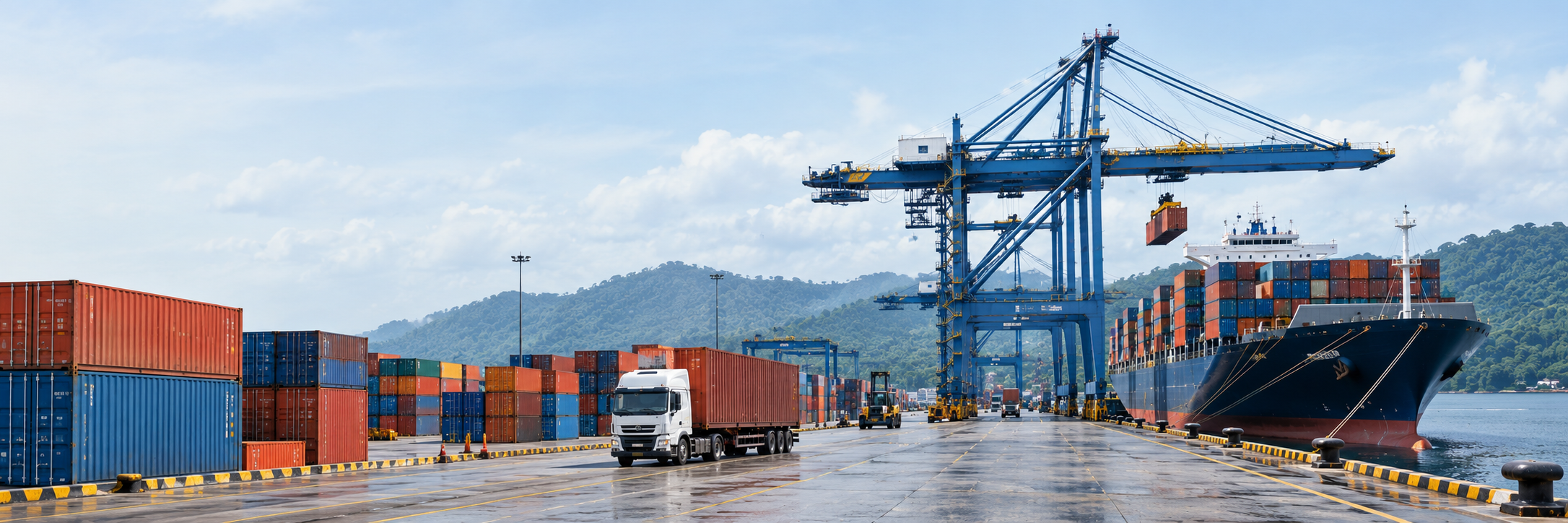
The Buenaventura Mayor’s Office will not apply the per-ton charge it set in August on cargo entering and leaving its port terminals. The per-ton charge in Buenaventura was COP 4,235 and drew opposition from trucking, coffee, poultry and foreign trade groups. Here is what it established, what it would have cost, how it was halted and who would have paid the most.
What decree 0338 established
On August 26, 2026, the Buenaventura District Mayor’s Office issued decree 0338. It created a “public price for circulation” of COP 4,235 per ton of cargo entering or leaving the district’s port terminals, adjusted every year with inflation (IPC).
In addition, the cargo owner, not the trucker, was the one who would pay. The charge would apply when the goods physically entered or left the terminal and would appear as a separate line on the invoice. Finally, the money was meant for mobility and infrastructure projects and to offset road wear caused by cargo transport.
What it would have cost
Per ton, COP 4,235 looks small. However, the effect shows up when you multiply it by the cargo that actually moves. For example, these are the per-operation figures calculated by Analdex, the foreign trade association:
| Operation | Cargo | Additional charge |
|---|---|---|
| Tractor-trailer | 30 tons | COP 127,050 |
| Loaded 40-foot container | 22 tons | COP 93,170 |
According to the national cargo dispatch registry, Buenaventura handles about 1,850 vehicles a day and roughly 55,500 cargo operations a month. As a result, ANDI, the national business association, estimated extra costs of more than COP 84 billion a year. Analdex added that, with the inflation adjustment, the rate would reach about COP 4,500 per ton in 2027.
These are estimates from industry groups, not official figures from the District.
Why the per-ton charge in Buenaventura drew so much opposition
Opposition came from several sectors at once, and each had its own argument:
- ANDI asked authorities to review the measure and look for other ways to fund the works Buenaventura needs.
- Colfecar, the trucking federation, warned that cargo transport has little room to absorb more costs and raised the possibility of double charging, since the sector already pays the Loboguerrero toll and the diesel surcharge. It also questioned a flat rate that ignores how long each operation occupies the roads.
- Likewise, the National Federation of Coffee Growers asked for dialogue before the charge was applied, since about six out of every ten sacks of exported coffee leave through this port.
- Fenavi, the poultry producers’ association, warned in turn that the port would lose appeal against other ports.
- Analdex also asked to see the technical, financial and mobility studies behind the rate.
- Finally, Fedetranscarga, another trucking association, pointed out that cargo owners would end up passing the cost on to the final carrier.
The Ministry of Transport called the measure inadvisable because of its effect on competitiveness. To put the stakes in perspective, the Ministry says more than 44% of the country’s foreign trade passes through this port area.
The underlying debate
Buenaventura’s complaint is not new. In fact, Portafolio’s editorial notes that the debt owed to the district is old and that the business groups themselves acknowledge it. The Mayor’s Office defended the charge as a price for using the roads and not a tax, and argued that cargo would not move to another port, since reaching an alternative means driving between 500 and 600 kilometers.
Still, the same editorial argued that this debt should be settled with planned, agreed public investment. It also warned that if one municipality can charge for goods crossing its territory, others could copy the formula.
How it was halted
After meeting with the Valle del Cauca Business and Trade Association Committee, Governor Dilian Francisca Toro confirmed that the Mayor’s Office would not apply the decree. She acknowledged that some of the arguments for the charge were valid, but said this was not the right moment to apply it.
Meanwhile, Mayor Ligia del Carmen Córdoba announced that the district will not apply the charge after a working session with Transport Minister Elsa Noguera. The session agreed to unblock works, improve port access and move forward on repairing roads damaged by the earthquake. On a separate note, the Ministry reported that nine of the 21 functional units of the Buga-Buenaventura corridor were unblocked.
What comes next
The issue is not closed. Sources say the district “will not apply” the decree, but we found no confirmation that it has been repealed. For now, the reactivation of the Logistics Roundtable is still pending, and it is meant to identify the port’s bottlenecks. The governor also put dredging of the channel, the Mulaló-Loboguerrero road and the water supply system on the table, works the city has requested for a long time.
Our view: who would have paid the most
The cargo owner paid the charge, so the hit would not have been evenly spread. In our view, a flat charge by weight punishes heavy, thin-margin cargo the most, such as agricultural bulk. For example, Asocaña, the sugar growers’ association, noted that Buenaventura is the main outlet for Colombian sugar: in 2025 the sector exported 624,000 tons to more than 60 destinations. On the import side, Fenavi flagged the effect on poultry feed, a cost that, according to Portafolio’s editorial, would end up in the price of chicken and eggs.
Overall, none of the exporters, importers or truckers came out ahead. Exporters would have faced a higher exit cost, importers a higher entry cost, and truckers extra pressure on their rates, in a sector that Colfecar says was already dealing with accumulated increases. Meanwhile, the only one collecting would have been the District, and industry groups were still asking to see the technical basis for the rate.
The precedent it leaves
There is also a precedent at stake. If every port district set its own charge by weight, the quote for an import or an export would become much less predictable.
A per-ton charge decided district by district changes the final cost of any operation without giving the customer a way to anticipate it.
If your cargo goes through Buenaventura
At Fenix Global Cargo we closely follow the decisions that affect costs at the country’s ports. So if your cargo leaves or arrives through Buenaventura, tell us about your operation and we will prepare a quote.
Get a quote on WhatsAppSources consulted
El Tiempo: Así se logró la suspensión del polémico cobro al transporte de carga desde Buenaventura
Forbes Colombia: Buenaventura, tarifa de transporte
Forbes Colombia: Buenaventura da marcha atrás y no aplicará el cobro al transporte de carga
Valora Analitik: Analdex advierte sobrecosto por sobretasa a la carga en Buenaventura
Portafolio: Gremios piden frenar cobro de $4.235 por tonelada en Buenaventura
Portafolio: Una carga nacional (editorial)
La República: Fedetranscarga pidió derogar el decreto de tarifa en Buenaventura
El País Cali: Ministra de Transporte destaca decisión sobre cobro a camiones
ABC Economía: El nuevo cobro a la carga en Buenaventura pone en jaque al café y al transporte
El Colombiano: Polémica en el puerto de Buenaventura por nuevo cobro por tonelada
PortalPortuario: Colombia, suspenden cobro por carga en Buenaventura

