
Two bottlenecks under increasing tension
The situation in the Middle East has escalated to a point where two of the most critical maritime routes for global trade are under simultaneous threat: the Strait of Hormuz and Bab el-Mandeb. On one hand, tensions between the United States and Iran have increased risks around Hormuz, including warnings of potential attacks on energy infrastructure and retaliation in the region. On the other hand, the Houthis have threatened to block passage through Bab el-Mandeb for vessels linked to the United States and Israel. Both corridors are essential for the transit of oil and goods. Any disruption in their operation directly impacts the continuity of international maritime trade.
Direct operational risk on key routes
Threats in Bab el-Mandeb introduce a new level of pressure on maritime transport. This passage connects the Red Sea with the Indian Ocean and is essential for trade flows between Asia, Europe, and Africa.
According to the provided information, the possible closure or restriction of this corridor would directly affect vessel transit, especially those associated with countries involved in the escalation of the conflict. At the same time, in the Persian Gulf, uncertainty around the Strait of Hormuz keeps the industry on alert, increasing operational risk and forcing shipping lines to reconsider their routes.
Route reconfiguration and pressure on capacity
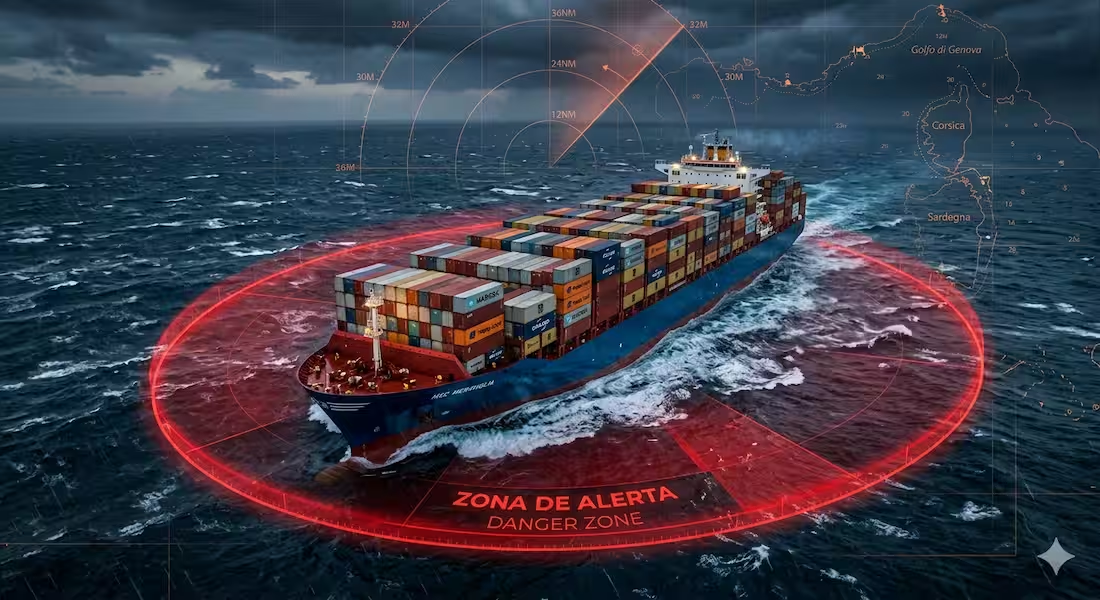
In response to this environment, shipping lines have begun evaluating operational alternatives. This includes route deviations to avoid risk zones, resulting in longer journeys and greater use of resources. These changes generate direct pressure on global logistics capacity. As vessels remain longer in transit, equipment availability decreases, affecting container rotation and creating imbalances across different markets. The result is a chain of effects impacting both planning and execution of logistics operations.
Oil surge and rising logistics costs
Tensions in the region have driven oil prices upward, a key factor for maritime transport. Since fuel represents a significant portion of operational costs, any increase directly translates into higher rates. This is reflected in rising surcharges, freight adjustments, and increased pressure on supply chains. As a result, the cost of moving goods increases, affecting both imports and exports.
Your cargo doesn’t wait. Neither do we.

Relief of sanctions on Russian oil in a volatile environment
At the same time, the relief of sanctions on Russian oil introduces an additional factor into the energy market, allowing more crude to be available internationally.
However, this element does not eliminate the uncertainty generated by risks in the Middle East. The coexistence of greater supply with threats to key routes maintains volatility in both prices and logistics planning.
Container shortages and operational disruptions
Changes in routes and extended transit times are affecting the normal flow of containers. Shipping lines have warned about possible disruptions in equipment availability due to these operational adjustments. This increases the risk of shortages in certain markets, difficulties in repositioning containers, and congestion at strategic points. The uneven redistribution of capacity adds complexity to the global supply chain.
Equipment shortage, port congestion… secure your cargo with us before it’s too late!
Extended transit times and uncertainty
Current conditions are also extending transit times. Deviations, security measures, and operational changes are causing delays that directly impact logistics planning. This situation forces companies to adapt to a less predictable environment, where delivery times may vary and inventory management becomes more complex.

Direct impact on export costs
The increase in logistics costs, along with oil volatility, directly impacts the final price of exports. Companies face higher transportation costs, reducing margins and affecting competitiveness in international markets. In this context, operational efficiency and adaptability become key factors in maintaining business continuity.
The following analysis corresponds to interpretations based on available information and recent developments. It does not constitute a confirmed fact and should not be interpreted as a definitive prediction.
If tensions in Hormuz and Bab el-Mandeb persist or escalate, logistics costs are likely to continue increasing, driven by fuel prices and operational adjustments on key maritime routes. Likewise, extended transit times could intensify imbalances in container availability. If the flow of Russian oil helps stabilize energy supply, some moderation in prices could be observed. However, operational uncertainty would remain a critical factor in global logistics.
Oil volatility, freight rates rising… secure efficiency and continuity with our team right now!
The current context requires more strategic logistics management. The combination of risks on key routes, rising costs, and potential disruptions forces companies to strengthen their response capacity. Having visibility, forward planning, and logistics alternatives becomes essential to mitigate impacts and ensure operational continuity.
- Los hutíes amenazan con cerrar el estrecho de Bab el-Mandeb a buques de EE.UU. e Israel
- Hutíes de Yemen advierten que bloquearán el estrecho de Bab el-Mandeb en apoyo de Irán
- Irán niega conversaciones con EE.UU. después de que Trump pospusiera ataques a la red eléctrica
- Trump amenaza con “destruir” centrales eléctricas de Irán si no abre el Estrecho de Ormuz en 48 horas
- Irán no cede tras amenaza de Trump de atacar centrales eléctricas si no abre el estrecho de Ormuz
- Cierre del estrecho de Ormuz: impacto en la cadena de suministro
- Actualización operativa 13 de Oriente Medio
- Aquí hay una actualización sobre las opciones de flujo de contenedores en la región del Golfo
- “Nuevo pico de disrupción” en Oriente Medio
- Guerra en Medio Oriente dispara recargos y extiende tiempos de tránsito en el sector portacontenedor